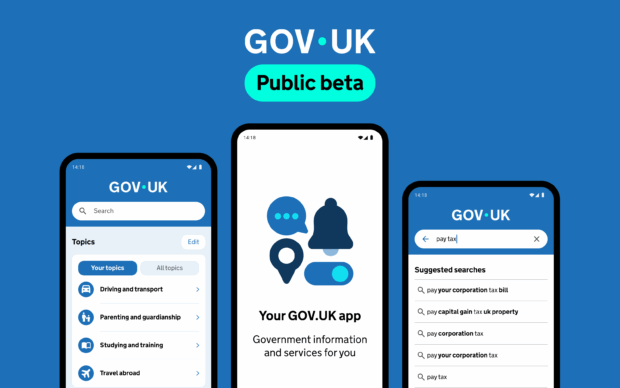
In July, GDS released the first version of the GOV.UK app, available for anyone in the UK to download. It was a big moment - for the first time, we’ve enabled people to have a more customised and persistent GOV.UK experience. The release was the culmination of months of user research, product design and technical expertise, so it was very exciting to see it out in the wild.
As of early October, there had been 140,000 downloads of the app. That number jumped to almost 260,000 as of 24 November, highlighting the great progress we’ve made in such a short space of time.
We’ve been spending these last few months carefully monitoring how the app is being used to make sure it meets user needs. This blog post sets out some of those insights, and how we’ll be building on them for the next stage of product development.
Kickstarting a new era of digital government
Before we dive into the data, let’s look back at how we got to this point.
The Blueprint for modern digital government, published in January, named the GOV.UK app as one of its 5 kickstarter initiatives. The kickstarters are intended to show our progress on delivering next-generation public services - with the app a central part of this, demonstrating how we will enable more personalised experiences for our users.
With over 60% of users to the GOV.UK website visiting via mobile devices, our data told us that users increasingly want and expect a mobile-first public service delivery, in line with other industries and indeed other governments around the world. After positive feedback from users in a private beta in spring, we were ready for a public launch.
Meeting users’ app-etite
The current version of the app in public beta is already delivering a more personalised, persistent and proactive experience.
It enables each user to easily tailor their homepage with the topics that matter most to them, and AI-powered search gives them the most relevant results. Because people are logged in, the GOV.UK app remembers the pages they have visited and what they’ve searched for previously, getting them quickly to the content they care most about. Users can also access their local council services quickly by entering their postcode, and can opt in to receive push notifications to stay informed of real-time updates and alerts.
What we’ve learned so far
The public beta release marked the transition from development to larger-scale, real-world testing. Over the last 5 months we have seen strong organic growth, with the app downloaded nearly 260,000 times. We’ve been learning about how these users are engaging with the GOV.UK app, gathering insight on how this first version is working, and what we can do to make it even better. We’ve been using Google Analytics to see how consenting users are interacting with the app, alongside an in-app survey.
Personalisation
Our personalisation features are really popular: over 80% of users have customised their homepage since launch, including adding their local authority. One piece of feedback even said: “Was much simpler to set up than I originally thought, love you can choose what’s relevant to your own circumstances.”
We see that return users are increasingly taking advantage of features we designed to give them shortcuts to get to content that is relevant to them, such as Previous Searches (22%) and Pages You Viewed (16%). This is an early validation that the features we have designed offer value to app users.
The content that returning users are coming back to the most includes Universal Credit, (re)booking Driving Tests and applying for apprenticeships. One respondent to the in-app survey said: “Easy to navigate through app. Very user friendly designed”. Whilst accessing web content in the app is working well in many places, we’ve also seen that there are some areas where this is limiting the experience for users: “I don’t like how the app mostly just links to web pages at the moment”, so we’ll be exploring how we get this balance right.
Positive response to nudges
We’ve seen some exciting results from both internal and external nudges such as in-app notifications or news about topical issues. Travel content prompts sparked interest and usage indicating they were timely and relevant. While external nudges, like articles on government topics such as pension articles and Companies House registrations, show that users are actively searching for the app as an alternative channel. Seasonal trends play a part too, with noticeable upticks around student services at the end of September.
What’s next
We are using all of this information to be data driven as we plan our next steps on the product to make sure we’re meeting user needs, delivering utility and value. In 2026, we will be:
- increasing the ways in which people personalise their experience based on the areas that matter most to them beyond web based content - so far this means we’ll be focusing on driving, benefits, local and travel
- working with a range of departments to identify services where there is an opportunity to natively deliver transformational experiences
- working with GDS Local to realise the ambition of making more GDS products and platforms actively available to local authorities
- we will also be building on a pilot we ran earlier this autumn, bringing the ability for users to ask questions in their own words and get answers though our AI-powered GOV.UK Chat
As we build out our capabilities and connect with government departments, we will continue to focus on providing frequent, incremental value through ongoing app releases.
Onwards!
The GOV.UK app is live in app stores. Download it now.
Subscribe to the GDS blog to get the latest updates about our work.
10 comments
Comment by Yusuf Sillah Jawara posted on
I really appreciate it, thanks
Comment by Nicolas posted on
Thanks for sharing these first insights!
(By the way, the “GDS Local” link seems to go through Outlook protection.)
Comment by GDS Comms Team posted on
Hi Nicolas,
Thank you for the comment. The link is working for us, please could you try again?
Best, GDS Comms Team
Comment by Robin Hayden posted on
The issue isn't whether the link works, but whether it should be a link that routes via Outlook instead of being a direct link to a gov.uk page. It looks like someone has copied and pasted a link provided via internal email into a public-facing webpage.
Comment by GDS Comms Team posted on
Hi Robin,
Thanks for the clarification, all updated now.
Best, GDS Comms Team
Comment by Steve posted on
Nicolas is right, the GDS Local link is pointing at [link].
Presumably you intended to link to https://gds.blog.gov.uk/2025/11/24/gds-local-goes-live/ instead?
It’s worth noting that Microsoft Outlook and Microsoft Word will add ‘safelinks protection’ to hyperlinks which you have to remember to remove when copying and pasting text into other places, like the GOV.UK Blog editing tools.
Comment by GDS Comms Team posted on
Hi Steve,
Thanks for the comment - edited out the link to remove personal information.
The GDS Local link is all updated now.
Best, GDS Comms Team
Comment by Ross Ferguson posted on
Thanks for the update. Useful insights for the increasing number of gov teams working on apps, guiding them on what to expect.
Could you say more about the usage metrics and what you are learning and contending with in relation to those?
What are the retentions - how many users returned after first install, and any trends around when?
And maybe sessions per user and how this compares to those of the GOV.UK website?
Comment by Tina Mermiri posted on
Hi Ross,
Thank you for your interest in this post and your question!
Four in nine users (44%) have returned to the app at least once since first logging in, with an average session count of 7.7 amongst them.
We are making some initial comparisons around usage and engagement between web and app, but differences in tracking, as well as visit purpose and product maturity make some of the metrics harder to compare without multiple caveats, statistical modelling and the necessary nuance/context. We think this might be a good area for us to blog about in the future when some of this has stabilised and the trends are more comparable.
We will also start capturing metrics like satisfaction and user experience scores to give us a better sense of user engagement and impact.
Best, Tina
Comment by Ross Ferguson posted on
Thanks Tina and team. Looking forward to those follow-on posts and the metrics and insights within them.