Devolution is not only about where decisions are made. It is also about whether places have the skills, tools and confidence to use digital, data and AI effectively.
Recent devolution and No10 North announcements set out the government’s ambition to put places at the heart of national decision-making and give local leaders greater capacity to deliver.
GDS and the Ministry of Housing, Communities and Local Government (MHCLG) are working together on “100 days of Digital Devolution” which kicked off on 1 September, centred on four themes:
- shaping mayoral and local government leadership
- building local capability and talent
- unblocking data foundations
- demonstrating practical AI, digital and cyber innovation
Together, these priorities are helping identify barriers, test ideas with councils and focus effort where it can have the greatest impact.
Here’s a breakdown on each area.
Shaping leadership and shared priorities
Effective digital devolution requires central and local government to develop shared priorities and come together in very new and different ways.
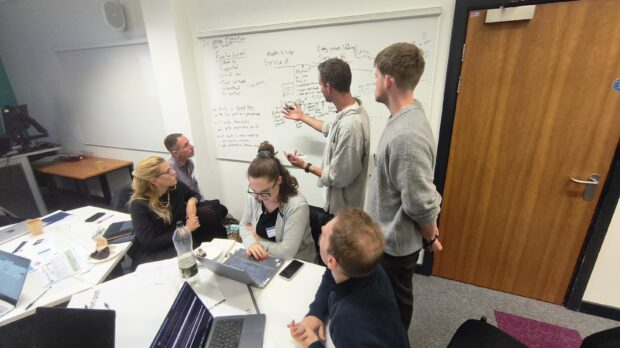
So we’re working on the draft content for the digital and data pillar in the Rewiring the State Delivery Plan and it has been brilliant for over 300 people from across local government and wider stakeholders to share their ideas and recommendations since 1 September. This culminated in a workshop on 21 September at Number 10 North with representatives from Mayoral Strategic Authorities and local authorities from across the country, together with senior professionals from GDS, MHCLG, Local Government Authority (LGA), Socitm, the Office for National Statistics (ONS), and iNetwork.
The session explored barriers around capacity and capability, data-sharing, re-usable products, governance and common standards. Participants highlighted the particular need for better access to government datasets, stronger support to adopt common standards and greater investment in digital and data capability.
We’re now working towards deadlines at the end of September and into October to refine proposals.
Building local capability and talent
Digital devolution depends on people as much as technology. Alongside strategic engagement, work is under way to strengthen the skills, confidence and delivery capacity needed across local government.
Applications are open until 25 September for a new Local Government Data Science Accelerator which will upskill participants to develop applied data and AI skills through practical learning that can be taken back into their roles. For information on how to apply, please email: ai-accelerator@dsit.gov.uk There will be other Accelerators coming if you miss this one!
In addition, Get Tech Certified launches on 1 October and complements this the Accelerator by providing access to industry-recognised learning and certification opportunities, helping to strengthen digital confidence and professional capability across the public sector.
Each initiative has a different focus, but both contribute to the same aim: supporting councils and Strategic Authorities to develop the expertise needed to use digital, data and AI responsibly and improve public services.
Unblocking data foundations
Places need access to the right data, governance and tools to make informed decisions and deliver more joined-up services.
Work is under way to reduce longstanding barriers to data access and sharing. This includes exploring reusable content for data-sharing agreements, providing targeted help around priority data-access challenges, and testing clearer routes for local government to request data from central government.
The programme is also exploring how authorities can better understand their readiness to access, govern and use data in support of devolved responsibilities.
There is a particular focus on supporting the findings of the independent young people and work report by the Rt Hon Alan Milburn, which aims to reduce the number of young people not in education, employment or training as part of a wider programme of activities. If you haven’t seen the recent post on the Vulnerabilities Data Standards Alpha posted on the Data in Government blog, please do take 5 minutes to digest it:
Taken together, this work is intended to make it easier for local government to use data safely and effectively, while reducing the need for individual authorities to solve the same underlying problems independently.
Demonstrating practical innovation
The intent here is testing how digital, data and AI can help address real local challenges.
On 9 September GDS Local and the National Data Library, South Yorkshire Combined Authority, MHCLG, Department for Education, Department of Health and Social Care came together to host The Early Years Innovation Challenge day with more than 100 people from local and central government, health, education and partner organisations. Participants explored how better data-sharing could support earlier intervention and improve outcomes for children and families.
Information about child development already exists across health, education and local services, but it is often held in different organisations, systems and formats. This can make it difficult for professionals to access the information they need at the right time and can require families to repeat the same information to different services.
Multidisciplinary teams used the Innovation Challenge to explore these issues, test assumptions and develop practical concepts that they presented to each other and a panel of (very supportive!) judges. The session helped distinguish where local flexibility should remain and where shared national approaches could prevent councils from repeatedly solving the same underlying data-sharing and service-coordination problems.
It was an incredible day and the strongest concepts will be explored further with partners who attended, helping turn local insight into action and identifying where further discovery, standards, policy or data work may be needed.
What we’ve learned so far
Together, these four priorities are clarifying what local government needs from central government: stronger capability, better routes to data-sharing, trusted governance, shared approaches and targeted support that reflects the realities of local delivery.
By shaping shared priorities, strengthening capability, removing barriers and testing innovation, the programme is helping build the foundations for longer-term Digital Devolution.
What’s coming next
Over the coming two months, work will continue across all four priorities, building on the engagement, capability and innovation activity already under way. In summary:
Shaping leadership and shared priorities
Over the coming months, we will continue to:
- work with local government partners to develop and refine priorities for digital and data-enabled devolution
- support engagement between Strategic Authorities, local government and central government on shared challenges and opportunities
- create opportunities for leaders to share learning and help shape the future direction of the programme.
Building local capability and talent
Upcoming opportunities to build skills and networks include:
- Get Tech Certified: providing free, industry-recognised learning and certification opportunities across the UK public sector. Launching on 1 October and running until 31 December 2026.
- Local Government AI Accelerator: offering a 12-week programme for local government data professionals to develop applied AI and machine-learning engineering skills. The first cohort is planned for October 2026.
- Government digital and cyber professions for all: promoting profession frameworks, learning opportunities and stronger capability networks across local and central government.
Unblocking data foundations
We’re continuing work with local government partners to:
- improve understanding of data-sharing challenges and opportunities
- support effective and responsible use of data
- identify opportunities for greater collaboration and consistency across the sector
Demonstrating practical innovation
Over the coming months, we will continue to:
- build on learning from the Early Years Innovation Challenge and other innovation activity
- explore how digital, data and AI can help address local challenges
- identify practical approaches that support stronger local capability and better public services
As the programme develops, the Government Digital Service will continue working with councils, Mayoral Strategic Authorities and partners across the public sector to strengthen the skills, tools and relationships needed for a more confident, digitally enabled local public sector.
For more information about this work, please contact the team.

2 comments
Comment by Tim Lennon posted on
Hello, super interested to understand how we can help our local councils to find out more, and maybe engage with parts of the programme. Is there a connection route for them?
Comment by GDS Team posted on
Thanks for the interest. There's a link at the end of the post to contact the team at workforceandcapability-programme-team@dsit.gov.uk. To hear more about GDS Local’s work and opportunities to get involved, you can also sign up to the GDS Local newsletter: https://forms.cloud.microsoft/pages/responsepage.aspx?id=BXCsy8EC60O0l-ZJLRst2Cav3xrtlwpAqUyj8EA3rPFUOVhDNDQ4WFBXSVI2U0dDR1U0VVk3WlQxSC4u&route=shorturl